Auto repair shop website: what yours needs to bring in cars
What an auto repair shop website needs: address and hours up top, a page per service, how your estimates work, real bay photos, and a short booking form.
18 min readTradeShopKit
- websites
- auto repair
- marketing
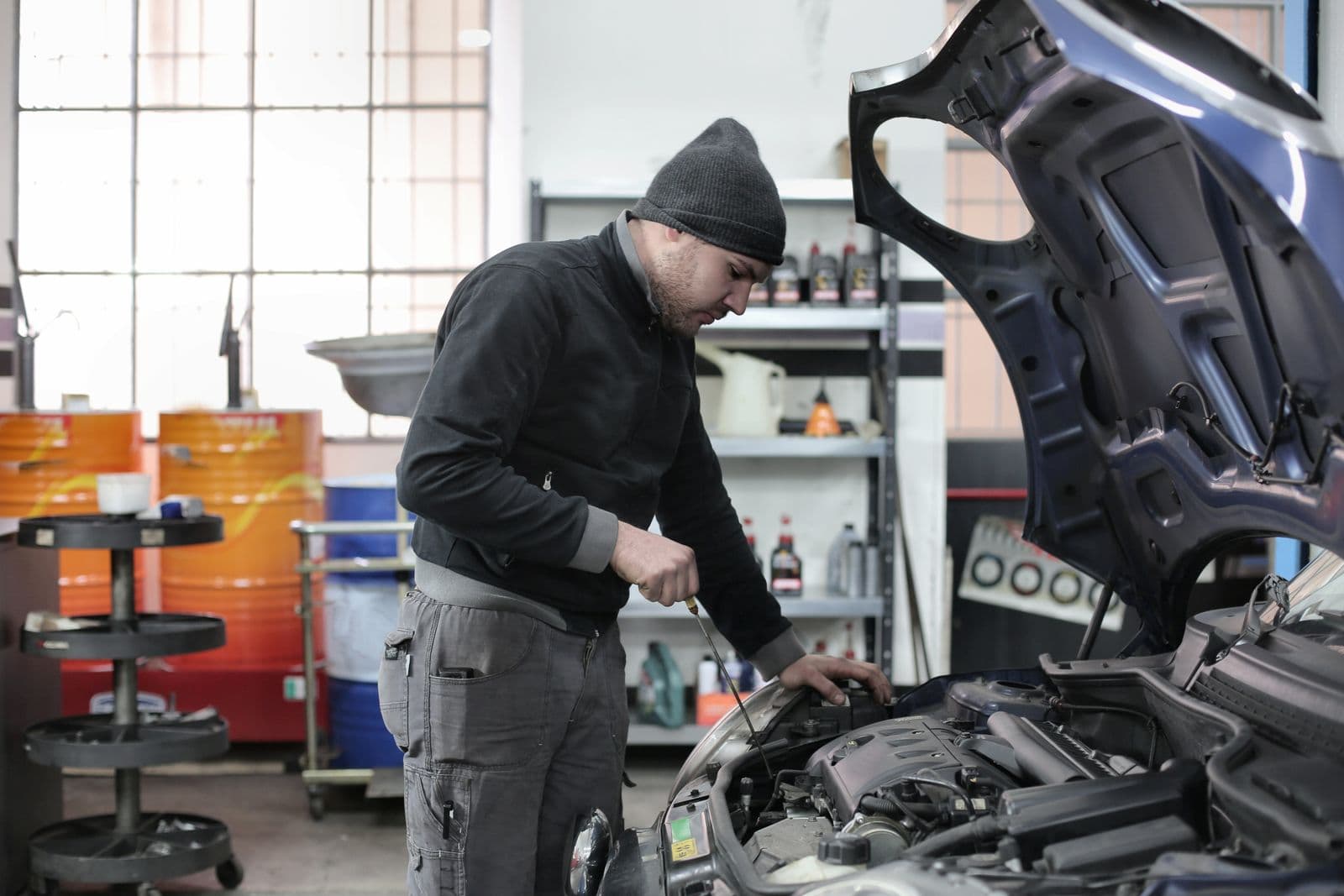
An auto repair shop website needs your address, hours and a tap-to-call number on the first phone screen, because unlike a plumber, your customer has to get the car to you. Below that it needs a page for each service you want more of, a plain explanation of how diagnosis and estimates work at your shop, real photos of your bays and your techs, and a short form to request a drop-off time. Most shop sites have a stock photo of a wrench and the words "Quality Service You Can Trust." That tells a nervous car owner nothing.
The checklist is at the bottom if that's all you want.
Who is looking at your site
Picture four people on a Tuesday morning.
The first has a check engine light that came on during the school run. The car drives fine. She's wondering if she can leave it till the weekend and what it'll cost to find out.
The second heard grinding from the front left when he braked coming off the highway. He knows it's brakes. He wants a rough number and a day.
The third just got a quote from the dealer for a timing belt job, and it was more than his rent. He's hunting for a second opinion from somebody who works on his make.
The fourth moved to town last month and needs an oil change and a shop she can keep going back to.
Every one of them is asking a different question, but underneath they're all asking the same thing: am I about to get taken? People walk into a repair shop expecting to be upsold. You know that, because you've watched them cross their arms at the counter. A good shop site spends most of its words answering that worry with specifics.
Your shop is a place, so act like one online
This is the big difference between your site and a plumber's or an HVAC company's. Their customers never see the office. Yours drive to you, hand over keys and need a way home.
So the location details that other trades hide are your front door:
- Street address, written out, linking to a map
- Hours for each day, including whether you're open Saturday
- Where to park and which door is the office (if it isn't obvious from the street, say so)
- Whether there's a key drop for early or late drop-offs
- Whether you offer a shuttle, a loaner, or you're a short walk from a bus stop or a coffee place
- How long the common jobs take, so people know if they can wait
That last one gets skipped all the time. "Oil changes and tire rotations are usually done while you wait. Brake jobs are usually same day if the car is here by 9." Two sentences, and half your phone calls just got shorter.
On Google, a shop where customers walk in during posted hours should show its address on its Business Profile. (If you also run a mobile service or do pickup and delivery, you can show the address and set a service area too.) Our Google Business Profile guide for contractors walks through the setup, and the Google Business Profile generator will draft the description and service list for you.
The pages an auto repair website needs
Drop whatever you don't do.
| Page | Who it's for | What it must include |
|---|---|---|
| Home | Everyone | Address, hours, tap-to-call, what you work on, links to your main services, one real photo of the shop |
| One page per main service | People searching that job | Symptoms, what you check, how long it takes, what changes the price, your warranty on the work |
| Diagnostics and estimates | The check engine light crowd | What a diagnostic visit includes, what it costs, how you get approval before doing any work |
| Makes you work on | Second-opinion shoppers | The makes and types you see most, and what you don't take |
| About | The careful ones | Owner's name, how long you've been open, tech certifications, photos of real people |
| Location and drop-off | Anyone ready to come in | Map, hours, parking, key drop, rides, wait times |
| Book or contact | Anyone ready | Phone, short form, when they'll hear back |
One page per service you want more of
Nobody types "automotive services" into Google. They type "brake repair near me," "AC recharge," "check engine light diagnosis," "alignment," "transmission shop." A single Services page with fifteen bullet points can't answer any of those properly.
You don't need fifteen pages either. Pick the five or six jobs that make you money and that you'd like to see more of in the bays. For a general shop that's often brakes, diagnostics, AC, suspension and steering, scheduled maintenance, and maybe tires or alignments if you have the rack.
Write each page in the same order:
- The symptoms, in the customer's words ("squealing when I stop," "the AC blows warm at red lights," "it shakes over 60")
- What you check first, and why
- How long the job usually takes
- What makes the price go up or down
- Your warranty on parts and labor, in plain numbers
- The phone number and the booking form again
The service page copy generator will give you a first draft for each one. Then go through it and swap anything generic for how you'd actually say it across the counter. If the draft says "our expert technicians will perform a comprehensive inspection," change it to what happens: "We pull the wheels, measure the pads and rotors, and show you the numbers."
Say what you work on (and what you don't)
The guy with the dealer quote wants to know one thing before he calls: do you see cars like his? If you work on mostly Toyotas, Hondas and Subarus, say it. If you do European cars, diesels, hybrids or fleet vans, say that. If you don't touch something (heavy trucks, body work, certain brands), say that too. It saves both of you a wasted call.
Honestly, "we service all makes and models" is the weakest line on most shop sites. It might be true. It also sounds like every other shop, and it gives the Audi owner no reason to pick you over the next result.
Explain how estimates work before they ask
This is the page that does the most to calm the crossed-arms customer, and almost nobody writes it.
Lay out the process in order:
- You bring the car in and tell us what it's doing
- We run the diagnosis, which costs a set amount (say what it is, and whether it comes off the bill if they go ahead with the repair)
- We call or text you with what we found, what it costs, and what can wait
- Nothing gets done until you say yes
- If we find something else once we're in there, we stop and call you again
- You can see or keep the old parts if you ask
For example, the diagnostics page might read: "A check engine light diagnosis is $X. That covers reading the codes and the testing needed to find the actual cause, which usually takes about an hour. We'll call you with the result and a written estimate. If you approve the repair, we take $Y of the diagnostic charge off the bill." (Use your own numbers and your own policy. Don't copy this if it isn't how you work.)
Sorting the estimate into "needs doing now," "soon" and "keep an eye on it" is worth a line on the page too. Customers remember the shop that told them something could wait.
In some states this process is the law. California is the clearest example. Its Bureau of Automotive Repair requires a written estimate with the specific job and the price for parts and labor before any work starts, and the customer's authorization recorded on that estimate. If the job grows past the estimate, the shop has to contact the customer with the new cost and get approval again before doing the extra work. Replaced parts go back to the customer if they asked for them when they authorized the job (core exchanges and warranty parts excepted), and the invoice has to show the shop's registration number and its business name as the Bureau has it on record.
Other states have their own versions, and some have none. Look yours up with the state's auto repair regulator or consumer protection office, then write this page so it matches what you're required to do. If your state gives you a registration number, find out whether it has to appear in advertising too. Your website counts as advertising.
Not legal advice. Rules change, check with your licensing board.
Prices: give people something
You can't quote a brake job without seeing the car. Customers mostly understand that. What they can't stand is a site with no numbers anywhere, because it reads like you're hiding them.
A middle path that works:
- A fixed price for the things that really are fixed: the diagnostic charge, a basic oil change by oil type, an alignment, a state inspection if you do them
- A "starts at" or a range for common jobs, with what moves it
- Your labor rate, if you're comfortable posting it (plenty of good shops do)
For example: "Front brake pads and rotors on most sedans and small SUVs: $X to $Y. Trucks, performance brakes and seized hardware cost more. We measure first and tell you if the rotors can stay." Again, your numbers.
Is your labor rate actually right? If you set it years ago by looking at the shop down the road, run your costs through the break-even rate calculator before you publish it. Our post on what to charge per hour walks through the math.
Show the shop, the techs and the paper on the wall
Stock photos hurt shops more than most trades, because the customer is about to walk into your building. If the site shows a spotless studio garage with a model holding a clean wrench and the real shop is a three-bay with a gravel lot, it feels like a bait and switch before you've said hello.
Take these on your phone on a bright morning:
- The front of the building from the street, sign visible, so people recognize it when they pull up
- The office or waiting area
- The bays with cars on the lifts
- Each tech, at work, with their first name in the caption
- Any equipment worth showing: the alignment rack, the scan tools, the AC machine
Then the credentials. If your techs hold ASE certifications, list who holds which ones and keep it current. Same for manufacturer training, emissions or inspection licenses, hybrid and EV training, and any shop program you belong to. Don't round up. A customer who asks "which of you is the master tech?" should get the same answer the site gave.
The about page generator drafts the owner story. Keep it short: who you are, where you learned the trade, when you opened, why you'd rather fix it right than sell a flush.
Warranty and dealer questions
Two questions come up constantly from people leaving the dealer.
One is your own warranty on repairs. Put it on every service page as numbers: months, miles, parts and labor, and what happens if the customer is out of town when something fails. A vague "we stand behind our work" doesn't count.
The other is whether having an independent shop do the maintenance affects the factory warranty. Customers ask this at the counter all the time. The federal Magnuson-Moss Warranty Act covers it. The FTC says the Act stops a company from making warranty coverage depend on the customer using a particular brand of part or service, unless that part or service is provided free under the warranty. In 2015 the FTC settled charges against BMW's MINI division over exactly that. There's a limit worth being honest about: if work done at an independent shop causes damage, coverage can be denied for that damage, though the warranty still stands for unrelated problems.
So don't write "going to an independent shop can never affect your warranty." Write what you do about it: you follow the manufacturer's service schedule, use parts and fluids that meet the spec, and give an itemized invoice with date and mileage for the customer's records.
The first screen on a phone
Somebody sitting in a parking lot with a warning light is on their phone. Before they scroll, the screen should show:
- A tap-to-call number in the header, as a real
tel:link, on every page - What you are and where: "Independent auto repair in East Mesa"
- The address, tappable, opening in their maps app
- Today's hours
- A "Request a drop-off time" button
Skip the slider of five rotating banners, the autoplay video, and the coupon pop-up that covers the phone number. And put a real sentence in the headline. "Brakes, diagnostics and AC for Toyota, Honda and Subaru, open Saturdays" beats "Your Trusted Automotive Partner" every time.
Booking: a short form beats a fancy scheduler
Online scheduling tied into your shop software is great if you already have it. If you don't, a short form does the job.
Ask for:
- Name and phone (and whether a text is OK)
- Year, make and model
- What the car is doing, in their words
- The day they'd like to drop it off
- Whether they're waiting or leaving it
That's enough. Don't make them enter a VIN and mileage to ask about a squeak.
What matters more is what happens next. Put a reply time on the form that you can actually keep ("We'll call or text back within two working hours") and then keep it. A drop-off request that sits unanswered until the next morning has usually been booked somewhere else by then. Our post on why quotes go unanswered covers the customer's side of that silence.
No-shows are the other half. A bay held for a car that never arrives is lost money. If you take deposits on special-order parts or charge for missed appointments, write it down and link it from the form. The cancellation policy generator gives you wording to start from.
Google, schema and reviews
Google says local results come down to three things: relevance, distance and prominence. It also says there's no way to pay for a better local ranking. For a shop with a fixed address, that plays out like this:
- Relevance comes from the right primary category on your Business Profile and service pages that match what people search
- Distance you can't change, so don't pretend to be in the next town over
- Prominence includes how many reviews you have and your rating, plus how well known the business is
Keep your name, address, phone and hours identical on the site, the profile and anywhere else you're listed. One version, everywhere.
For schema (the small block of code that tells search engines what your business is), Google's local business guidance says to use the most specific business type that fits, with name and address required and phone, URL and opening hours recommended. Schema.org has an AutoRepair type (described simply as a car repair business). It sits under AutomotiveBusiness, which sits under LocalBusiness, so use AutoRepair over the generic type. One catch: Google says pages where a business controls the reviews about itself aren't eligible for review stars from this markup. Put reviews on the page for people to read, and don't expect stars in search from your own code.
Page speed matters as well, since a lot of your visitors are on mobile data in a parking lot. The targets and the usual fixes are in our plumbing website checklist, and they apply to a shop site the same way.
On reviews: ask every customer, at pickup, when they've just driven the car around the block and it's quiet again. Send the link by text so it takes them a minute. Don't offer a discount on the next oil change for a review. Google's policy bans offering payment, discounts or free goods or services in exchange for any review, and it bans asking only your happy customers. The review request generator writes the text message, and how to get more Google reviews covers the rules in full.
Then use the reviews where they fit. A review that says "they told me my rear brakes had another 10,000 miles left" belongs on the brake page.
What to leave off
- A blog you'll update twice and abandon
- A "Specials" page with a coupon that expired last spring
- A parts catalog widget nobody uses
- A live chat box that nobody at the shop answers
- Logos of every parts brand you've ever installed, crowding out your own name
- Town pages for places you don't serve, with only the town name changed
Auto repair website checklist
Open your site on your phone and go down the list.
First screen
- Tap-to-call number in the header on every page
- Address, tappable, opening in maps
- Today's hours
- What you work on, in one plain sentence
- A drop-off request button
- No slider, autoplay video or pop-up over the number
Pages
- One page per main service, with symptoms, time, price factors and warranty
- Diagnostics and estimates page that says nothing happens without approval
- Makes and vehicle types you take, and the ones you don't
- Location page with parking, key drop, rides and wait times
- About page with the owner, the techs and current certifications
Money
- Diagnostic charge stated, and whether it comes off the repair
- Fixed prices or ranges for common jobs
- Repair warranty in months and miles
- Deposit and missed-appointment policy written down
Proof
- Real photos of the building, the bays and the people
- Reviews placed on the service pages they mention
- Any state registration or license shown the way your state requires
Technical
-
AutoRepairschema with name, address, phone, URL and hours - Name, address, phone and hours match your Google Business Profile exactly
- Photos compressed, speed checked in Search Console
- Google Analytics and Search Console connected
Don't want to build it yourself? The Trade Website Bundle is a five-page site written for your shop, with click-to-call on every page, a quote request form, Google Business Profile setup, and Google Analytics and Search Console connected. It includes domain and hosting for the first year, goes live within 10 days or your money back, and costs $399 one-time (it was $500), with nothing monthly required. After year one, domain and hosting renew at the provider's price. More free tools for shops are on the auto repair hub.
Quick answers
What should an auto repair shop website include?
Address, hours and a tap-to-call number up top, a page for each main service, an explanation of how your diagnosis and estimates work, the makes you take, real photos of the shop and techs, your repair warranty, and a short drop-off request form.
Should an auto repair shop show its address on Google?
Yes, if customers come to the shop during posted hours. A shop that also offers mobile service or pickup can show the address and set a service area as well.
Does using an independent repair shop void a car's warranty?
Not by itself. The FTC says the Magnuson-Moss Warranty Act bars tying warranty coverage to a named brand of parts or service unless it's provided free. Damage caused by faulty work can still be denied.
Should I put prices on my auto repair website?
Put the ones that are truly fixed, like your diagnostic charge, and give ranges with what changes the price for common jobs. No numbers at all tends to make people suspicious.
Do I need online booking on a repair shop website?
No. A short form asking for the vehicle, the problem and a preferred drop-off day works, as long as someone replies within the time the form promises.
Can I give a discount in exchange for a Google review?
No. Google's policy bans offering payment, discounts or free goods or services in exchange for any review, good or bad.
Start with the estimates page
Write down, in six steps, what happens between a customer handing over the keys and you picking up a wrench. You already explain it at the counter a dozen times a week. Put it on the site, add your diagnostic charge and your warranty, and you've answered the question every new customer is too polite to ask.